RegMatch Prototype
AI-assisted regulatory policy review for healthcare teams
Overview
ROLE
Design Engineer
PLATFORM
Desktop web app
TECH STACK
React, Vite, Claude Code, Figma
TIMELINE
6 hours
Both of my parents recently retired, and helping them understand their health coverage sent me down a rabbit hole into Medicare Advantage. Medicare Advantage is a public–private model. Rather than the federal government directly administering a person's benefits through Original Medicare, CMS contracts with private insurance companies to administer Medicare Part A and Part B benefits - and, in most cases, prescription-drug coverage - on its behalf.
That delegation creates an oversight challenge. Plans must follow federal Medicare rules while making everyday decisions about provider networks, coverage, prior authorization, appeals, and member communications. CMS audits plan sponsors to evaluate whether they are meeting their contractual and regulatory obligations, including how they deliver services and administer benefits.
For the teams responsible for those reviews, compliance work means translating hundreds of regulatory requirements into evidence that can be traced back to internal policy. Reg Match was designed to make that work faster, clearer, and more auditable, to support the oversight that helps hold plans accountable to the people they serve, including my parents.
System Architecture

 uploads
 streams
 queriesmatches
 opens PDF
Input
Regulatory checklist
PDF document
Interface
React client
Upload and review UI
Vite middleware
/api/reviews
Session orchestration
Parser
pdf-parse
Document ingestion
Session data
Extracted text + session
Normalized document context
Anthropic
Identify requirements
Structured checklist extraction
Knowledge source
Policy PDF index
Searchable policy corpus
Retrieval
Lexical evidence search
Requirement-level matching
Structured output
Requirements
Individual review criteria
Evidence
Page + excerpt
Traceable source citation
Anthropic
Draft status
Proposed finding and rationale
Document access
Source-PDF route
Original page viewer
Review interface
React review workspace
Evidence, status, and source side by side
Human in the loop
Reviewer confirms + exports
Final decision and CSV output
Browser persistence
localStorage save / resume
Review progress retained locally
Research and Discovery
Planning the MVP
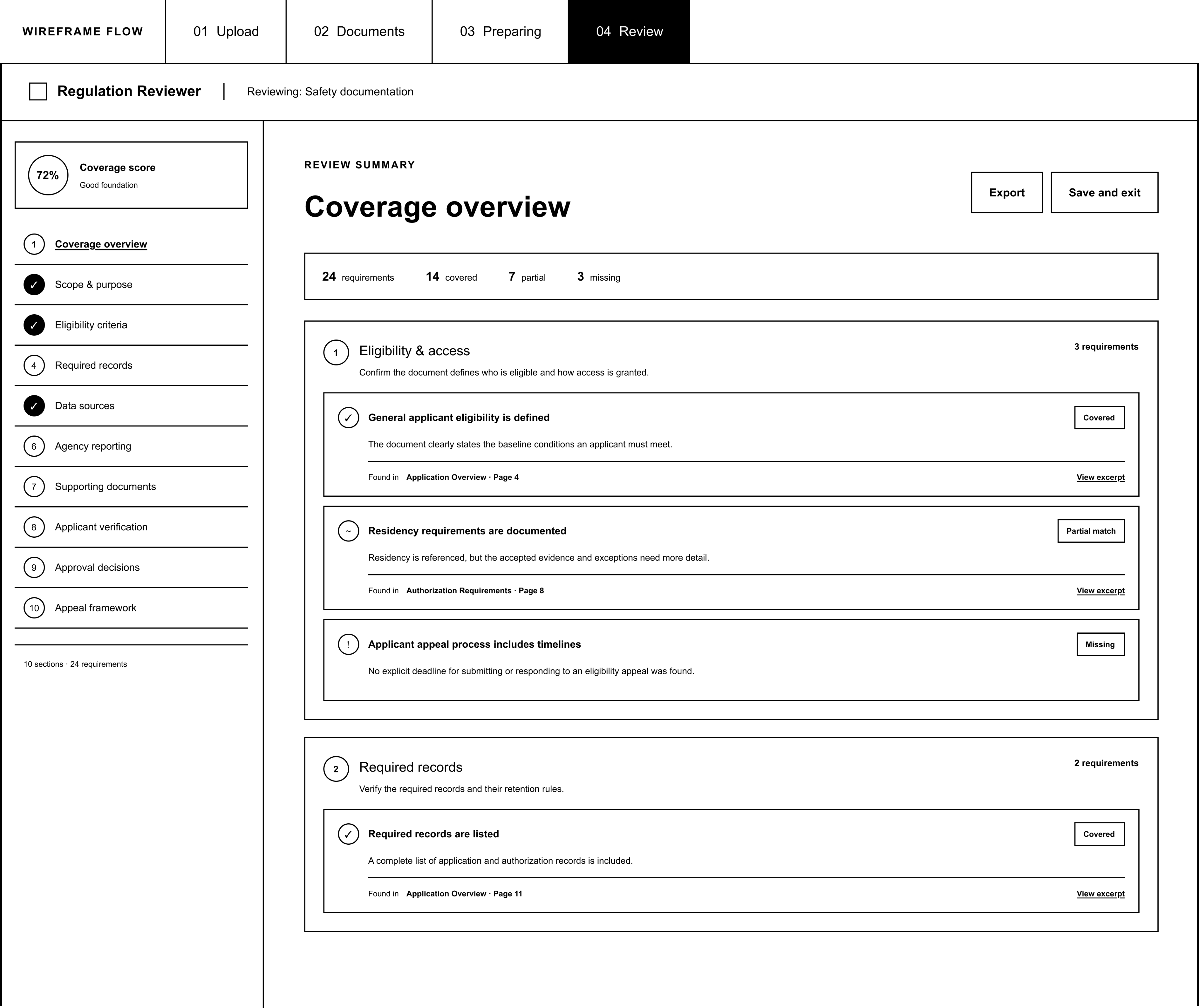
Medicare Advantage audit teams receive more than 300 regulatory requirement documents each year. Reviewers must interpret each requirement, search a large policy library for supporting evidence, and document a traceable response for the final audit.
Reg Match turns that work into a structured workflow: it extracts requirements from the source document, surfaces candidate policy evidence, and gives reviewers a source-linked workspace to inspect and confirm every match.
I started with the smallest complete workflow:
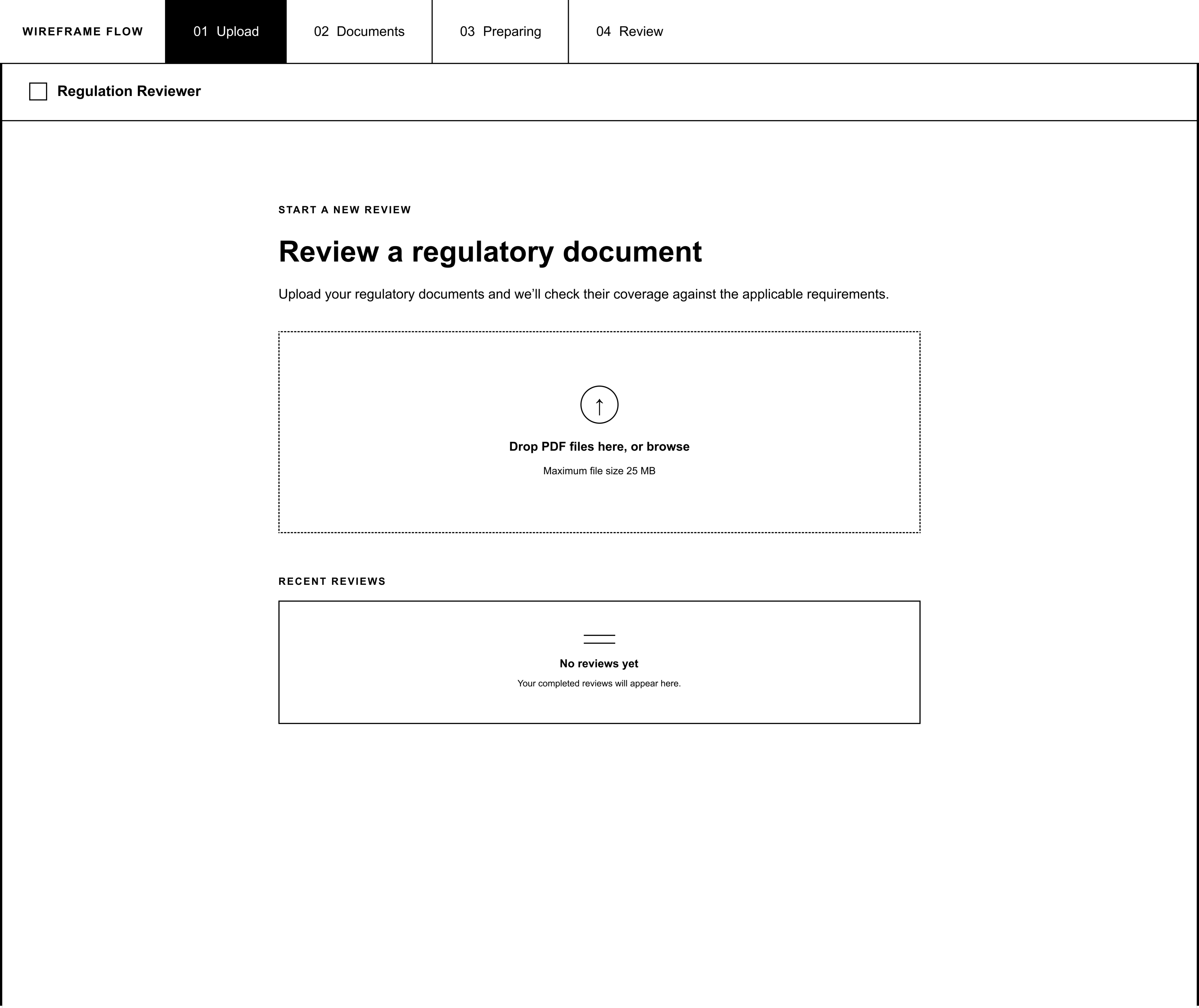
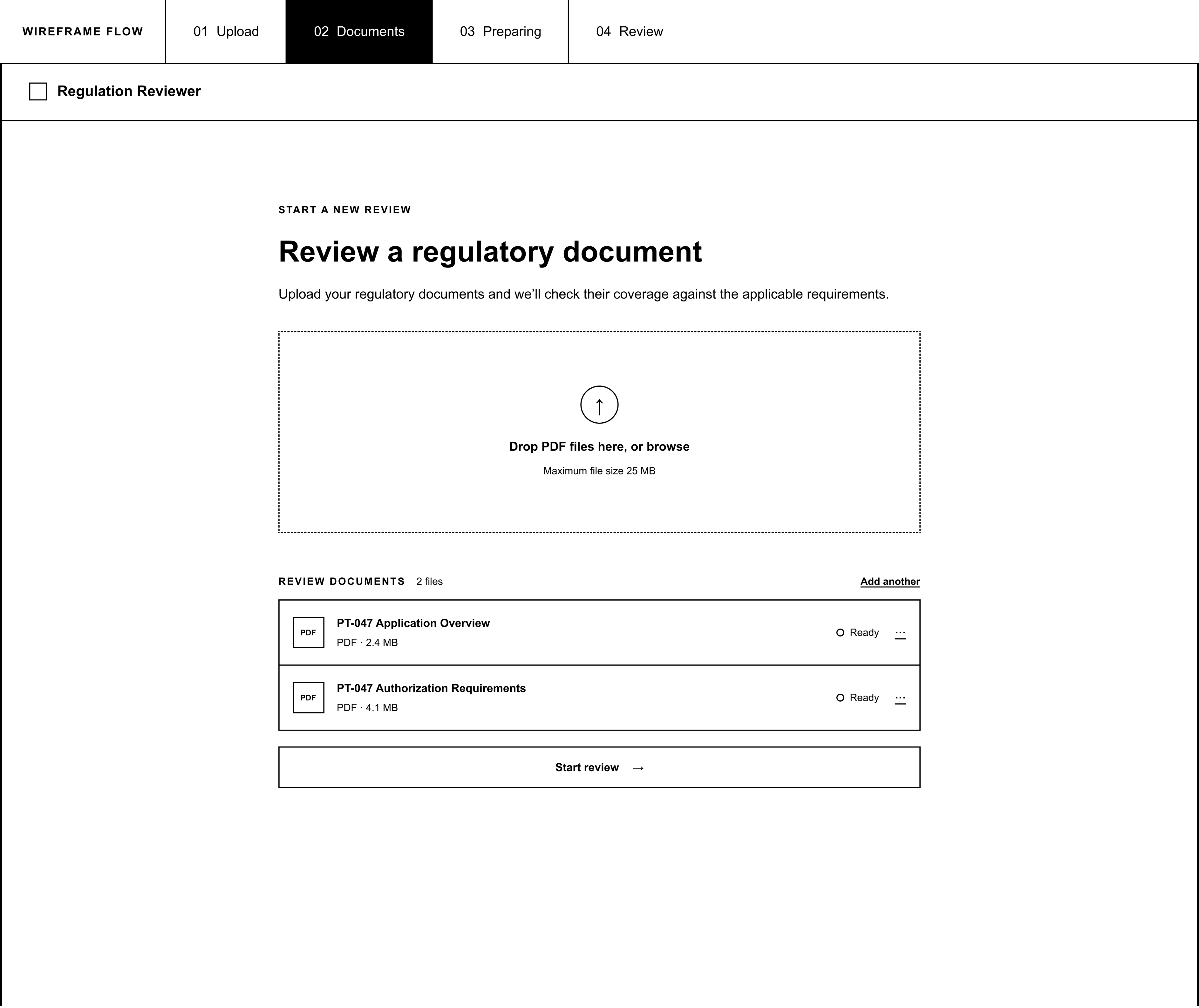
- Upload a regulatory PDF.
- Extract its review requirements.
- Search a library of policy documents for potential evidence.
- Let a reviewer inspect and explicitly confirm every decision.
- Export the completed review with preserved citations.
Challenge and Solution
Turning a PDF into a review workspace and evidence search, designed for transparency
The first prototype focuses on a real hospice review form: a 14-page document containing 64 review findings, evaluated against a library of 373 policy PDFs.
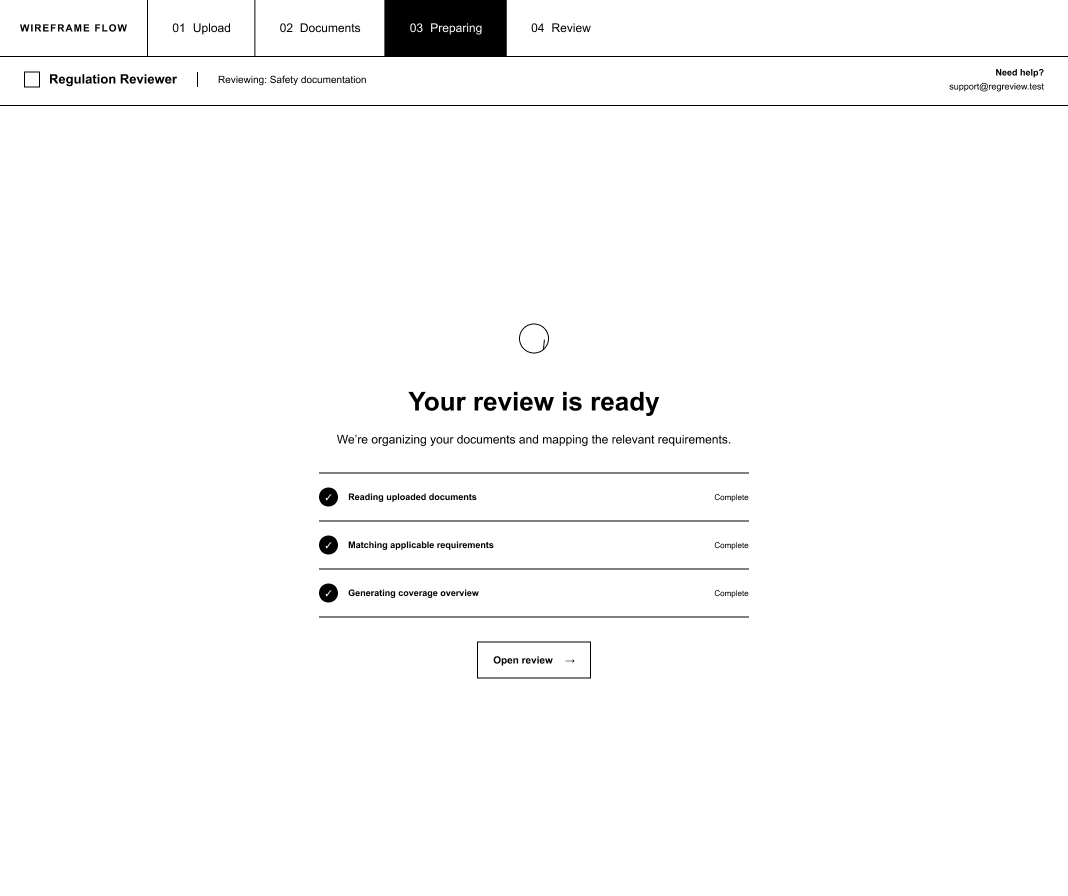
Reg Match reads the uploaded PDF locally, then asks Claude to identify its explicit review requirements as validated structured data: numbers, titles, source references, and categories. For text-rich documents, it sends extracted text to reduce cost and latency; for scanned PDFs, it falls back to the original file. I used a Server-Sent Events stream to report live progress while Claude works - showing the number of requirements found so far - but wait for the complete, validated response before starting evidence search.
I pre-indexed the policy library by page. Instead of re-reading all 373 PDFs every time a reviewer evaluates a requirement, Reg Match searches prepared policy text, filters out common terms, and ranks likely matches by keyword overlap.
Indexing made the workflow both faster and more traceable: reviewers get likely evidence quickly, then inspect its exact source in context. They can also search the library manually or upload an additional policy when the initial search does not surface useful evidence.
Processing the regulatory PDF to identify all the requirements
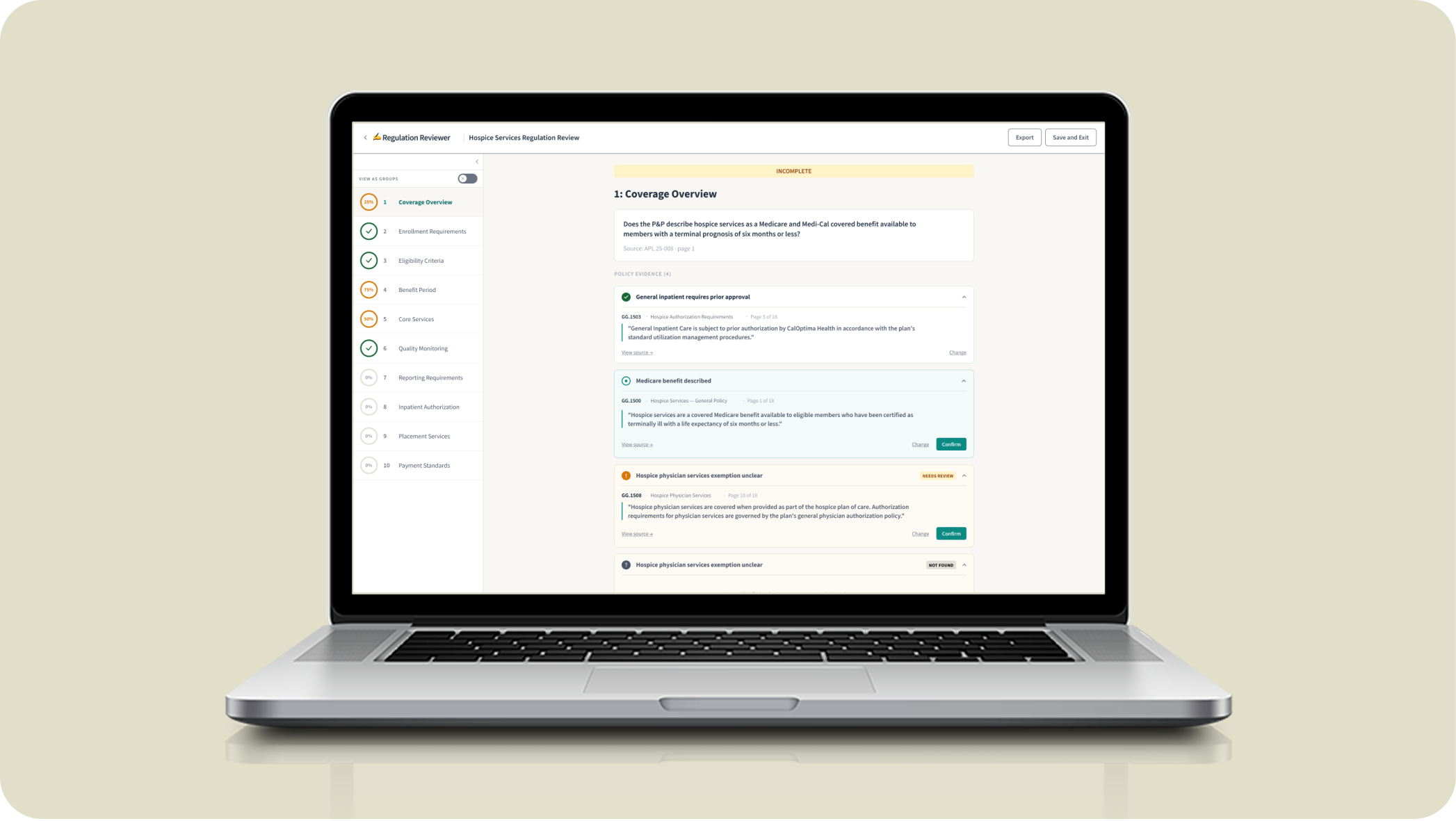
RegMatch converts an uploaded regulatory document into structured requirements. Each one receives a short title, review text, source reference, and category label.
Categories use the document's own section headings when available; otherwise, the model creates concise topic-based groupings. The interface preserves that order, transforming a long PDF into a navigable review outline instead of a flat checklist.
Viewing requirements individually or grouped
Reg Match uses lexical search to surface candidate policies, then selects the passage where the most requirement terms appear together. It expands the excerpt to complete sentences and maps it back to the relevant PDF page. Each recommendation includes a readable excerpt, source policy and page number, in-context PDF viewer, draft status, and explicit confirmation control.
AI can label evidence as supported, needs review, or not found - but the reviewer makes the final decision. The goal is to reduce the work of finding evidence without obscuring where it came from.
Fulfilling requirements by confirming matching evidence, searching the library, or uploading new policies
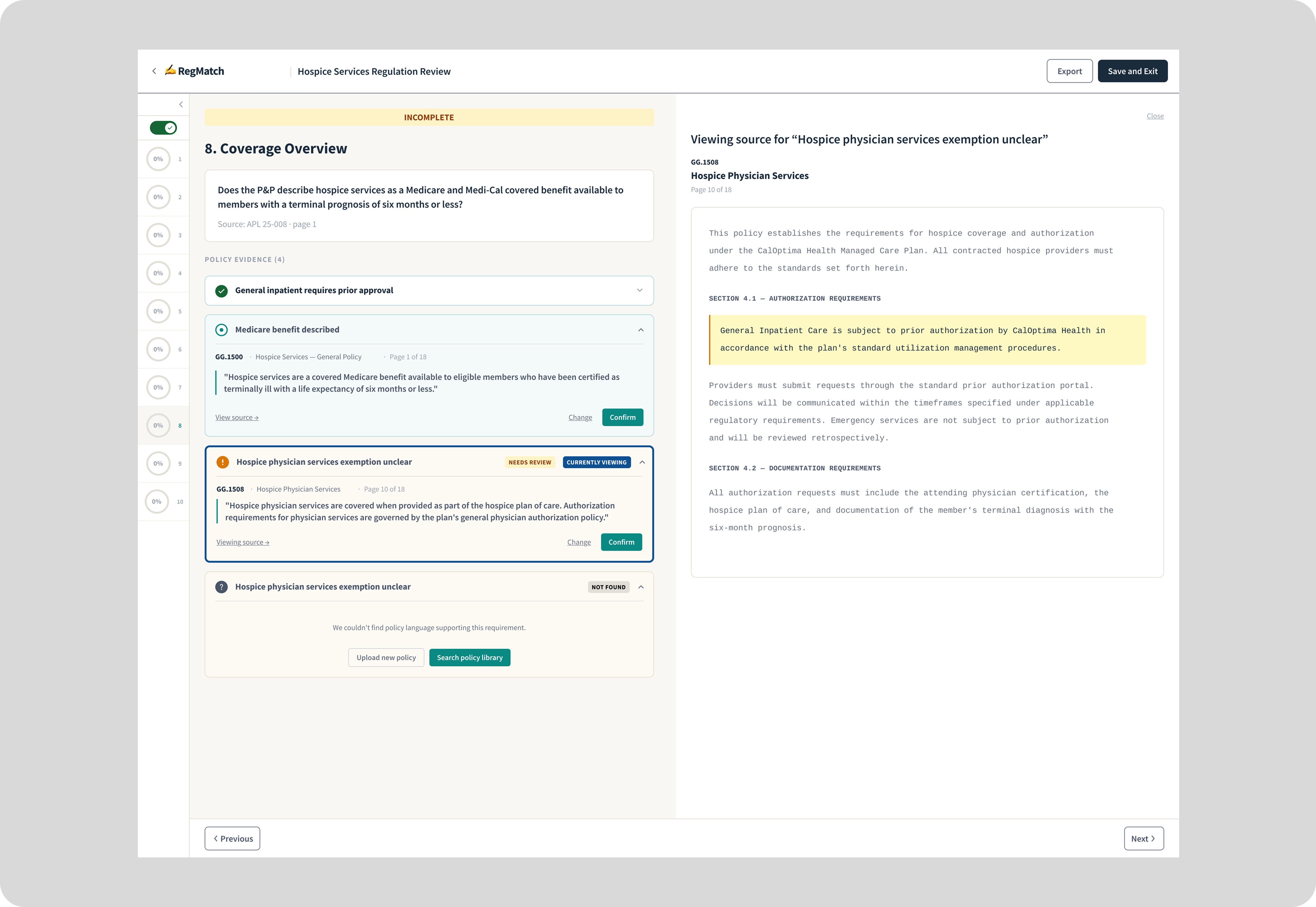
Viewing a policy source
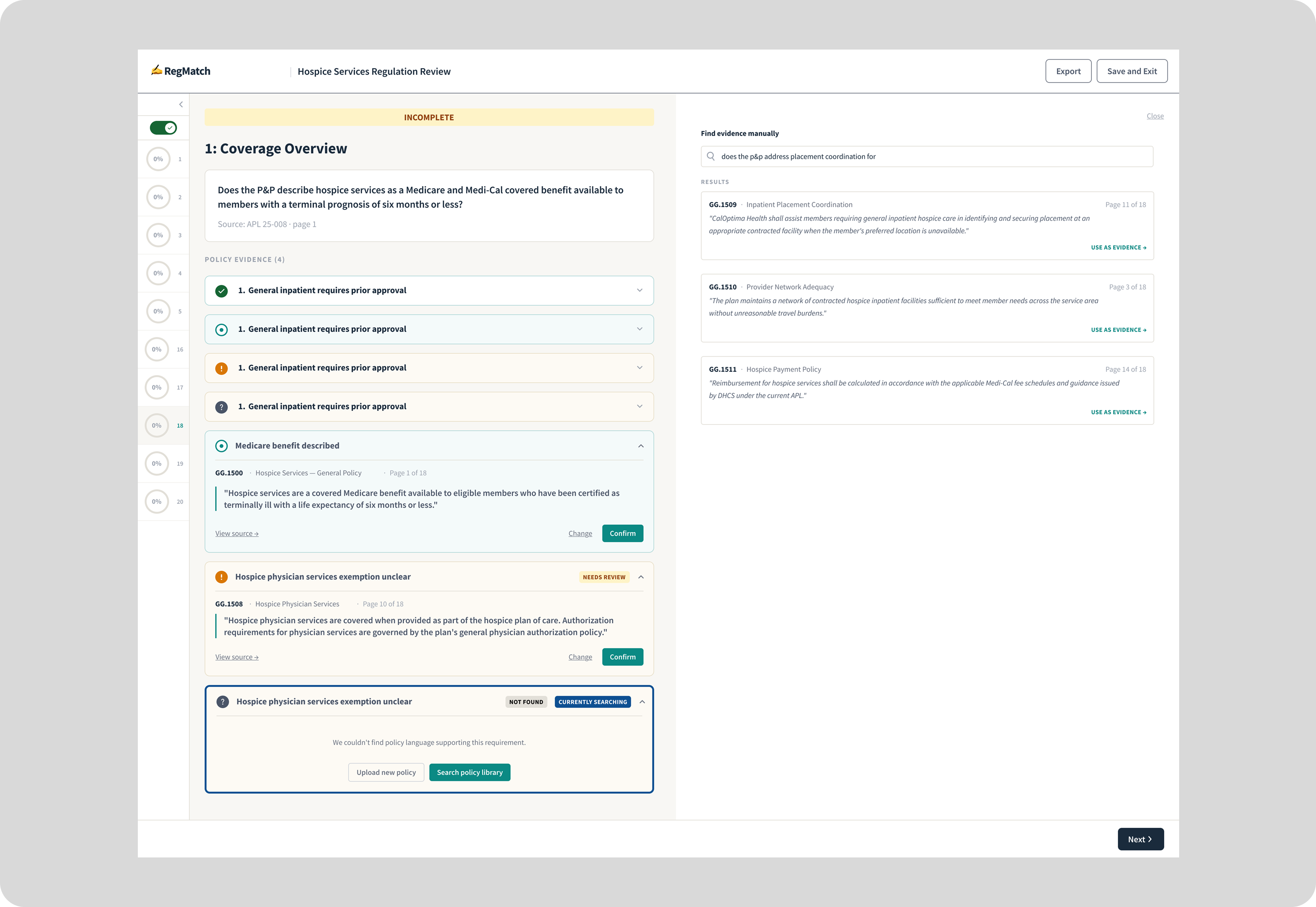
Manually searching for evidence within the policy library
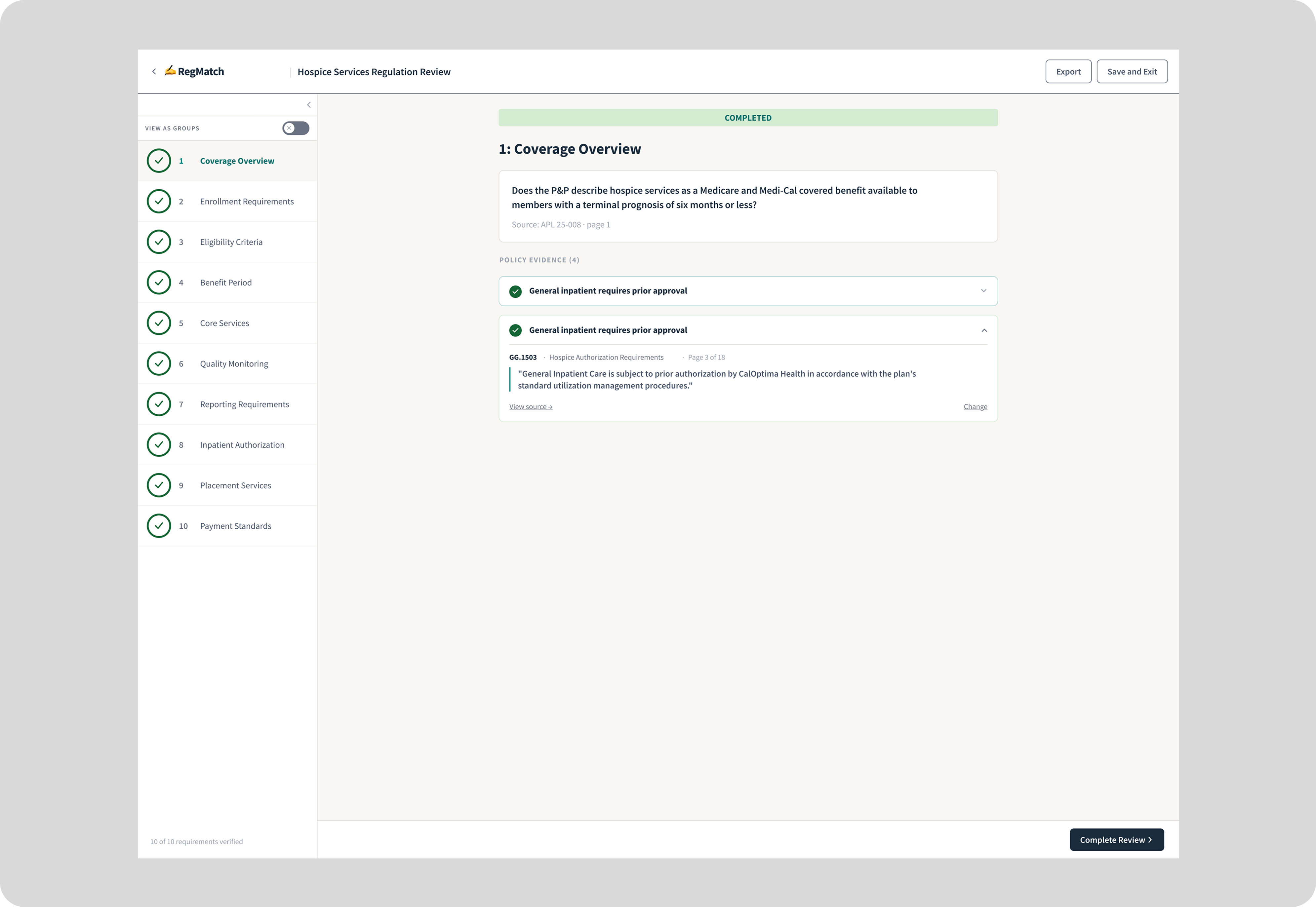
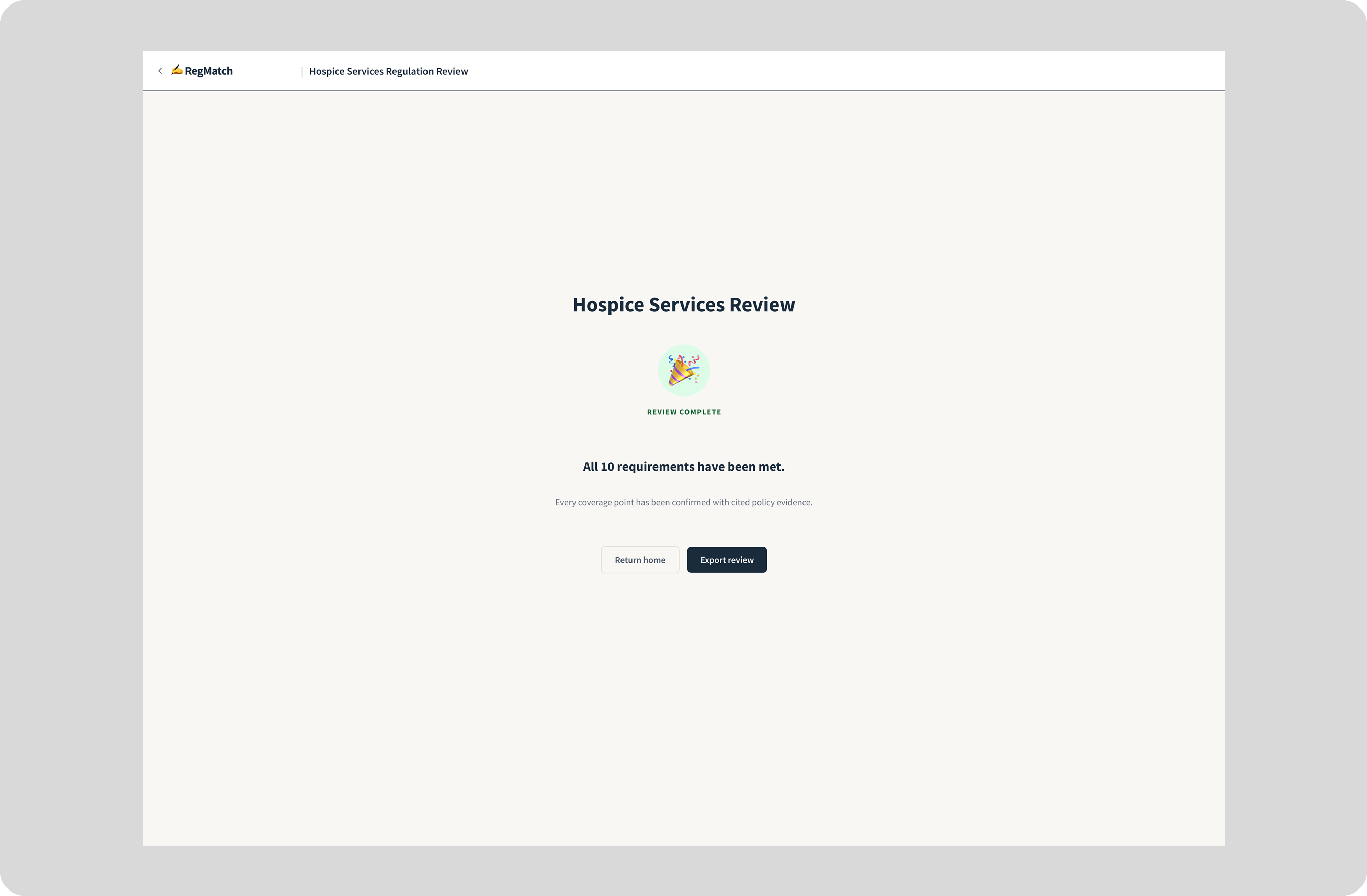
All requirements are met
Results and Learnings
From MVP to a faster system
After the workflow was working end to end, I focused on its bottlenecks.
I moved standard PDF text extraction to run locally, then sent extracted text to Claude rather than repeatedly asking the model to process an entire document. For scanned or unreliable PDFs, the system falls back to the original PDF to preserve accuracy.
I also restructured evidence retrieval. Instead of generating snippets and page citations for every policy with any keyword overlap, the system ranks the full library first, then creates detailed evidence only for the top results.
On the 64-requirement sample, that reduced evidence-search time from roughly 7 seconds to 0.3 seconds - about a 23× improvement - without changing the returned matches.
AI-native products are not just chat interfaces layered onto an existing workflow. The meaningful work was deciding where automation could accelerate review, where the system needed to show its reasoning, and where a person needed to stay in control.
Reg Match is a prototype, but it demonstrates a practical direction for AI-assisted policy review: faster document processing, traceable evidence, and deliberate human confirmation before a decision is final.
View the Github repo and live prototype.